JAKARTA, 10 February 2026 —The Center for Sustainability and Waste Management Universitas Indonesia (CSWM UI) stood as a key participant during the official launch of the PS-RISE program on Tuesday, February 10, 2026. Hosted at Bank Sampah Induk Satu Hati in West Jakarta, the event introduced a strategic roadmap by the Indonesian Plastic Recycling Association (ADUPI) for Polystyrene Recycling Innovation and Sustainable Economics. This initiative seeks to modernize waste banks by integrating them directly into the national recycling industry supply chain.
The program addresses the persistent challenges of current waste bank models, which are often limited by small collection volumes and a general lack of investment attractiveness. To overcome these hurdles, PS-RISE focuses on transforming these facilities into professional collection hubs through business management up-skilling and the adoption of advanced automation technology, including AI sorting machines, press machines, and conveyor belts. Complete transparency across this new ecosystem is maintained through digital implementation using the ADUPI POS and ADUPI Trace platforms.
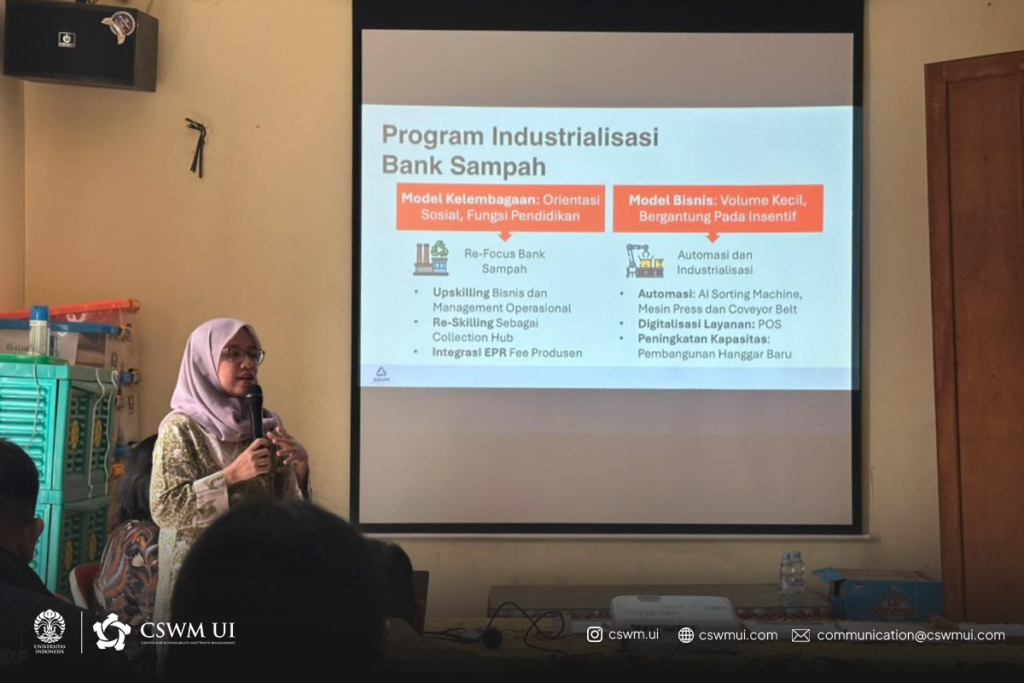
Financial viability for this industrial shift is secured through the integration of Extended Producer Responsibility (EPR) fees, providing waste banks with premium off-taking prices and the economic certainty required for long-term growth. Beyond economics, the launch served as a platform to correct common misconceptions about Polystyrene (PS), noting that BPOM RI has confirmed styrene migration levels remain safely below the 60 ppm threshold. Scientific assessments further show that producing PS utilizes 80-88% less energy than paper-based alternatives and provides essential insulation for food quality at temperatures as low as -40°C. With a mechanical density of 1.04 g/cm³ compared to 0.9 g/cm³ for other plastics, PS remains a durable and highly functional material for both medical and food applications.
CSWM UI advocates for this shift from mere awareness to systemic integration, supporting pilot collection systems that engage waste banks and local governments directly. Starting from a baseline recycling rate of 16.3% in 2025, the program targets an increase to 20% by 2028 through strengthened collection networks and expanded public participation. CSWM UI remains committed to this collaborative effort, ensuring that polystyrene is managed through a robust circular economy framework that benefits both the environment and the national economy.